In the physical world, waste is easy to spot. You can see a book gathering dust on the back shelf. You can see the wear and tear on a popular bestseller. But in the digital landscape, waste is invisible, and it’s quietly draining library budgets across the country.
Digital content should remove barriers, yet most platforms are designed to create them – forcing patrons onto months-long waitlists for files that live in the cloud. Between “buy-expire-rebuy” metered licenses and skyrocketing platform fees, libraries are trapped in a cycle that shrinks their collections by 10% or more every year1.
At Hoopla, we’ve always believed in a different path. We first challenged the status quo in 2008 when we were primarily selling physical media. While publishers pushed for higher prices in the library market (library editions), we took the opposite approach – leveraging the first-sale doctrine to manufacture durable, drop-box-friendly audiobooks for roughly $35 instead of $100, proudly saving public libraries millions of dollars since then.
We created Hoopla to leverage digital and mobile access to your library without the holds and waitlists (in the spirit of patron-driven acquisition). There isn’t any waste or gambling on which title will be popular.
1. The Hybrid Approach: Why Integrated Access is the Only Sustainable Path
Most platforms force you to choose between a huge bill or a huge waitlist. Hoopla uses our pioneered Instant model (on demand) and Flex (one copy/one user) together so you can say ‘yes’ to your patrons today without compromising your budget tomorrow. Here’s how we do this:
- Eliminating Digital Waste: Most waste happens when libraries pay upfront for metered licenses that never circulate or expire before earning their value. In fact, 70% of metered licenses never reach 50% utilization, and 10% never circulate at all2.
- Instant Guarantees Utilization: Every Instant borrow represents real patron demand. There is no unused inventory and no expiring assets. Instant handles unpredictable viral spikes so you don’t over-buy, while also providing a cost-effective home for content with expired licenses.
- Flex Adds Strategic Control: Libraries retain ownership options for select titles (the “core” of your collection) without being forced to tie their entire budget to inefficient structures.
- No Platform Fee Shock: While competitors are doubling platform fees for many libraries in 2026, Hoopla remains committed to transparent, usage-based pricing. We charge zero platform fees, ensuring library budgets are directed toward content for patrons, not toward sustaining platform profits.
- Libraries can transfer all metered and perpetual titles to Hoopla at no charge.
Understanding the Landscape: A License Comparison
To manage a budget effectively, you have to know exactly what you’re buying. Here is how the four main digital license types stack up for the modern library:
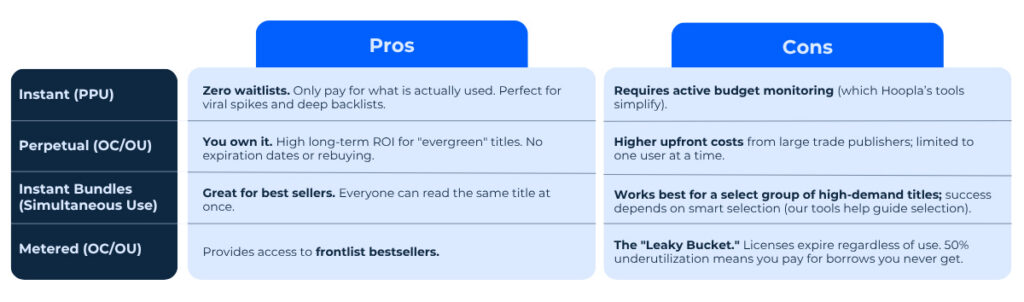
2. Pricing Advocacy: Breaking the “Buy-Expire-Rebuy” Loop
Just as we fought for $35 physical audiobooks in 2008, we continue to advocate for fair library pricing in the digital age. This advocacy is built into our business model.
- Strategic Licensing: We do not offer Instant (on demand) from certain publishers, such as Penguin Random House; these titles are exclusively available through Flex (one copy/one user). Why? Because we prioritize licensing models that make fiscal sense for a library’s bottom line. While some competitors offer Penguin Random House titles at $3.99–$9.503 per circulation (reflecting premium library pricing models) we advocate for more equitable pricing grounded in true value and sustainable cost per circ.
- The Math of Savings: When looking at Hoopla’s Instant pricing compared to Overdrive’s cost per circ (CPC) pricing for the top 100 audiobooks in January of 2026, the gap between Hoopla and the alternative isn’t just a few cents – it’s a chasm4.

- Commitment to Stability: We prioritize keeping Instant pricing accessible, avoiding titles above $3.99 USD. Today, fewer than 4% of titles are priced at $3.99, with an average cost per circulation around $2.245.
Metered license costs have increased by over 200% since the pandemic6, forcing libraries to sacrifice backlist and diverse collections just to keep up with bestsellers. Hoopla breaks that cycle, allowing your collection to grow with lasting depth rather than shrinking by 10% annually.
3. Data Transparency and Constant Innovation
The nature of expiring metered licenses increases the challenge of meeting patron demand and measuring your true cost per circ (CPC). But, at its core, this isn’t just a metered-license issue – it’s a transparency issue. Some platforms calculate cost per circ (CPC) using incomplete data, overlooking expired or underutilized titles across both metered and perpetual collections.
Without the full picture, it’s difficult for libraries to fully understand what they’re paying for or how their budget is being used. At Hoopla, we provide a clear, complete view so you can make confident decisions and ensure every dollar supports your community.
We provide total data transparency. We share your true CPC, including granular reporting that helps you steer your budget responsibly. Beyond the data, we provide the tools to act on it. We are constantly innovating with products designed to challenge the metered license dynamic:
- Instant Bundles: A powerful way for libraries to serve high demand while managing costs. By pre-purchasing a set number of Instant borrows for popular titles (such as Harry Potter or Onyx Storm), libraries enable simultaneous access for multiple patrons. With Hoopla’s buying tools, libraries can easily see when usage reaches the savings threshold, the average cost per circulation drops significantly – reducing holds while keeping budgets predictable. These are intentionally designed for a targeted set of high-demand titles, with data-driven tools that help libraries determine exactly where Bundles make sense.
- Holds Relief: Automatically moves high-demand titles to Instant access when waitlists peak, ensuring patrons get content now without the library needing to buy excess copies that quickly lose relevance. With approximately 50% of Flex titles also available on Instant7, libraries have built-in flexibility to meet demand in the moment while keeping collections efficient.
- BingePass & Bonus Borrows: We pioneered these models to make budgets go further – offering unlimited streaming of great content or providing free borrows to patrons that don’t cost the library a dime.
Choose Growth Over Attrition
Artificial scarcity doesn’t have to be your reality – it’s a choice that puts profits before libraries. Every year you spend in the metered-license loop, your collection loses ground and your budget is wasted on assets that simply disappear.
Hoopla’s hybrid approach is the only model designed to actually grow your library’s reach while protecting its fiscal health. It’s time to stop renting a shrinking shelf and start investing in a sustainable future.
We are excited to continue the conversation on breaking the cycle of metered waste. You can’t build a future on invisible waste and hidden data. It’s time for a transparent model that puts the control (and the budget) back where it belongs: with the library.
To learn more about the data featured in this article, please reach out to info@midwesttapes.com.
Data sources:
1 Derived from data provided by a large library system, analyzed on October 8, 2024 and June 25, 2025, for year-over-year comparison.
2 Based on OverDrive data reviewed by Midwest Tape/Hoopla across 22 public libraries from 2006 to 2025.
3 Based on pricing data for Penguin Random House titles, where cost per circ (CPC) is typically set at ~10% of the Library Digital List Price (LDLP), resulting in per-circulation costs generally ranging from $3.99 to $9.50.
4 Pricing data was sourced from OverDrive’s website on January 26, 2026. At the time of analysis, 90 of Hoopla’s top 100 audiobooks were also available on OverDrive, enabling a direct pricing comparison.
5 Reflects the 2025 average cost per circulation across all Hoopla formats, including music, video, audiobooks, eBooks, comics and manga, and BingePass/SeasonPass.
6 Based on average metered license pricing from the Big Five publishers (Penguin Random House, HarperCollins, Simon & Schuster, Hachette Book Group, and Macmillan) spanning 2019 through 2025.
7 As of March 18, 2026, 1,246,968 out of 2,500,000 Hoopla Instant titles are also available as Flex titles.